



Norton Hall: 0121 328 3043
Dolphin Centre: 0121 326 8343
Hover over a tree for more information.
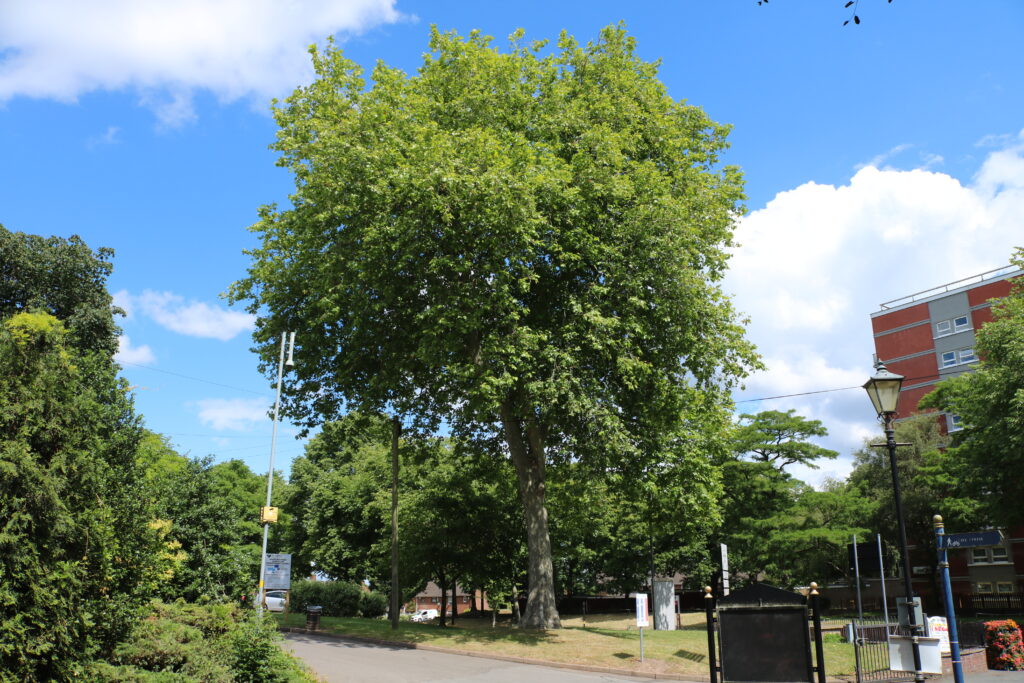
This huge tree guards the main entrance of the park. It has leathery leaves similar in shape to the palm of the hand. Its bark peels off to show patches of lighter bark, making a lovely pattern. It is thought to be a cross between the Oriental plane and the American Sycamore, which were cross pollinated in London in the 17th century to produce a new hybrid.
The large leaves start green in spring and turn to a golden brown in the autumn. The fruits are produced in spiky clusters which hang from stalks on the tree for most of the year. London Pine produces attractive timber which in some countries is used for veneer and flooring.
Fun fact: London Planes are often found in large cities. It is commonly thought that their ability to shed their bark enables them to resist the pollution of the city, but this is not true! The shedding of bark is not connected to the pollution.

As you move further into the park, to your left, slightly set back from the path you will see an interesting looking tree with four trunks. This is a Cedar of Lebanon, which unsurprisingly is native to Lebanon and the eastern coast of the Mediterranean. This tree can be identified by dark green deedless, black-ish brown bark and multiple trunks.
Fun fact: This tree is the national emblem of Lebanon, and is featured at the centre of the Lebanese flag.

As you approach the house from the main entrance of the park, you will see a blue-grey Atlas Cedar to your left. This majestic tree can be easily identified, as it does not lose its needle-like leaves in winter and has round cones which stay on the tree all year. Atlas Cedars were first introduced to the UK in 1841 and is native to Algeria and Morocco. Atlas Cedars are currently being used as a plantation species for forest restoration in southern France. In the Middle East, cedar wood was used to build major buildings such as temples. The wood was also a source of essential oil similar to turpentine and was used to make cough medicines, ointments and antiseptic.
Fun fact: The Egyptians imported cedar oil from Lebanon for embalming the dead.

As you walk up to the house, you will see a bright green tree on the right. This tall tree has striking, deeply furrowed bark, making it easy to identify. The Acacia, commonly known as Black Locust, is native to North America and was introduced to Europe in the 17th Century. . As well as serving ornamental purposes, False Acacias are often planted to prevent soil erosion, as they have nitrogen-fixing bacteria on their root systems that help to enrich soil. You can also look out for the hanging clusters of white, scented flowers in June. These are a nectar source for bees and yield a high quality honey. The fragrant flowers are also used in perfumery.
(No so)Fun fact: Some parts of the plant are toxic, particularly the bark, and poisoning of humans and livestock have occasionally been reported so be cautious
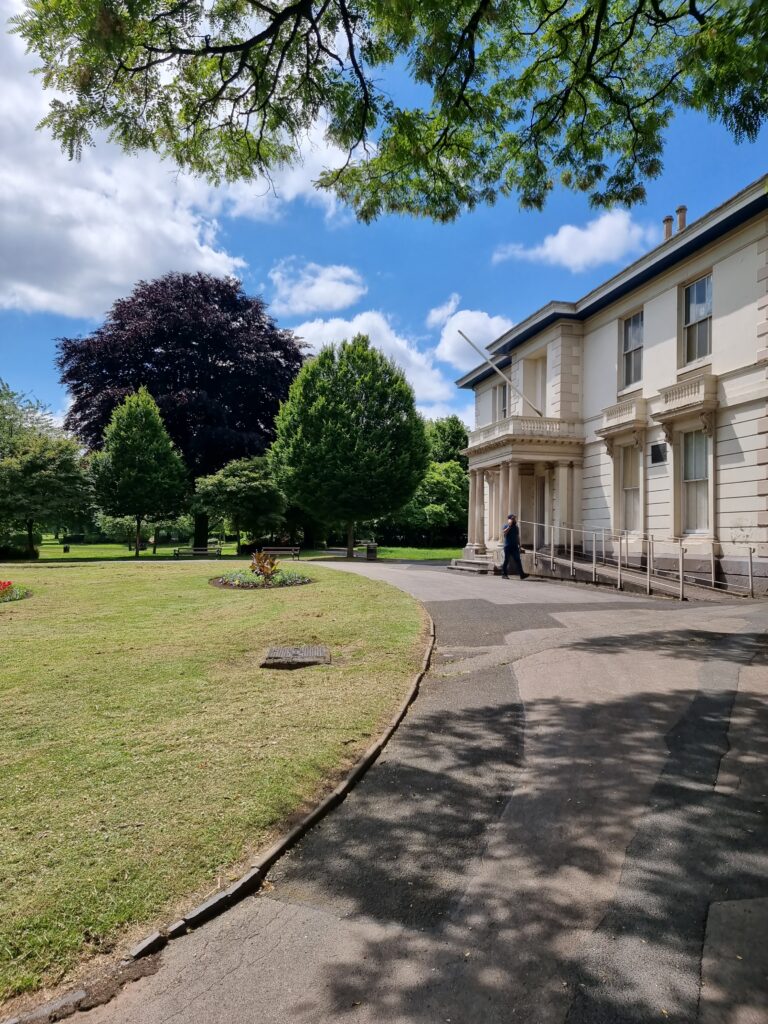
This very pretty tree next to the house (to the left) is related to the common Beech. It is especially designed to grow this lollipop-like shape. This tree was planted in May 2004 by the then Lord Mayor Cllr John Alden, at a festival event to celebrate the Centenary of the opening of Ward End Park. Look out for the commemorative plaque nearby on the wall of the house. Hornbeam timber is the hardest wood of any tree in Europe, and the name derives from “horn” meaning hard, and “beam” being the old English word for tree. Historically these trees were Britain's most prized source of hardwood, used to make tools, coach wheels and gear pegs in traditional windmills. The Hornbeams creamy white timber was also used by the Romans to make their chariots because of the strength of the wood.
Fun fact: A tonic made from hornbeam was said to relieve tiredness and exhaustion and its leaves were used to stop bleeding and heal wounds.

This impressive evergreen tree opposite the house is likely to have been planted by the owners of the house in 1885, making it at least 140 years old. There are two types of cedar in the park, the younger grey Atlas and this greener Himalayan. This tree is native to the Himalayan Mountains from Afghanistan to north-western India and is the national tree of Pakistan. Plant hunters brought it back in 1830’s to grow in nurseries. It became fashionable to plant such new exotic trees near your house to impress visitors. The wood is strong and fragrant and due to its religious association was often used to construct temples and palaces.
Fun fact: The Himalayan Cedar is worshipped as a divine tree; Its name originates from “deodar” meaning “timber of the gods”. According to Hindu mythology, Kamadeva, the god of love, struck Lord Shiva with an arrow as he meditated under a deodar tree. His intention was having Shiva fall in love with Parvati.
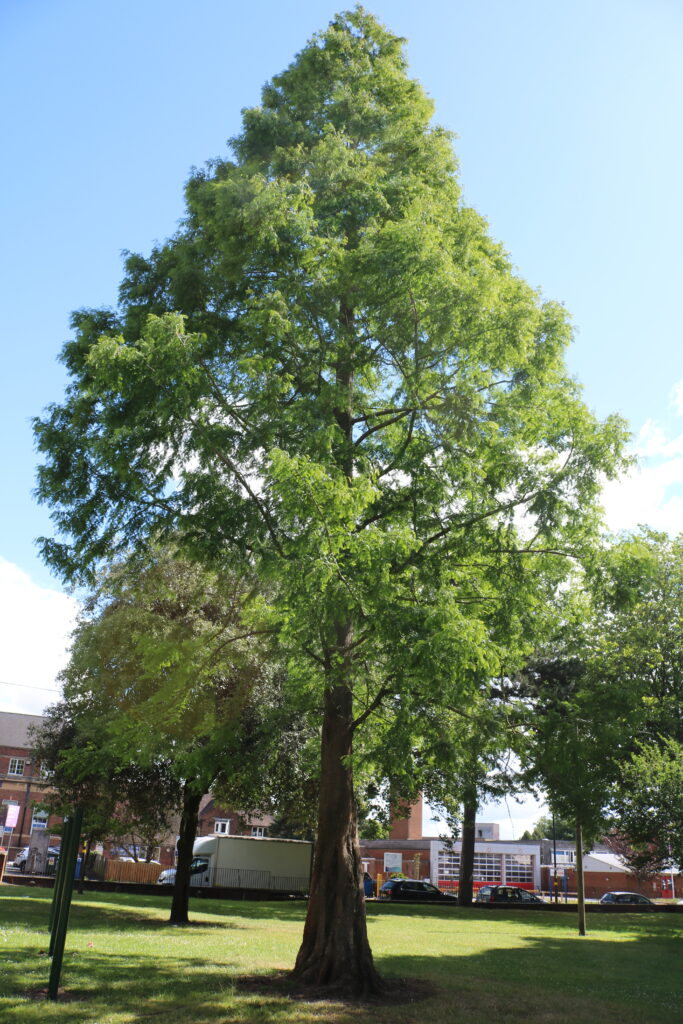
Further back past the Himalayan Cedar stands a tree with a very strange and beautiful trunk. Trees in the Redwood family were thought to be abundant when dinosaurs roamed the Earth. Today, only 15 species of Redwood exist. The Dawn Redwood was only known as a fossil until 1941, when it was discovered in a remote part of China. Seeds were collected and taken to America where they were grown and distributed throughout the world. Unusually for a conifer, its light, feathery green foliage turns to a deep brown in the autumn before dropping to create a stunning bronze carpet of soft needles on the ground.
Fun fact: Before its discovery in 1941, it was only known from fossil records dating back 100 million years, and was believed to have been extinct for 5 million years. Most amazingly, recent studies into its history - including looking at wood preserved in amber - have shown that this tree likely has remained unchanged for millions of years. It also happens to contain a rich collection of medically important compounds (some previously unknown to science) that might prove to be useful in treating everything from cancer and skin allergies to the flu.

Back towards the path you will find a very sturdy looking Red Oak with a thick trunk. This is a relative of our native English Oaks. Its natural home is North America where there are huge forests of large trees. It is often planted as an ornamental tree for its flaming autumn colour. The leaves Dark green in colour, they have a paler, matted appearance on the underside, and fade to a bright red before falling in autumn. Its trunk is smoother than our native oaks. The Red Oak is a valuable tree for wildlife in the park. It’s loved by insects in the springtime, as its catkins are a great source of pollen for bees and other insects. Its acorns are also eaten by birds and small mammals.
Fun fact: It takes 20 years before red oaks flower, and a further 20 before they produce a good crop of acorns.

Beech trees are another type of tree that can be spotted at multiple points along the tree trail, with one in particular (number 9 on the trail) being especially hard to miss. This magnificent tree is one of the largest in the park! Its branches sweep down low, so you can just walk underneath it and look up into its canopy. We think that this tree is well over 150 years old! This green leaf common beach is native to Europe. It is the largest-growing beech, reaching a mature height of at least 25m and forming a wide-spreading densely branched canopy with a minimum spread of 15m. Its leaves are a light and intense bright green in colour when first opening in spring, with a covering of silky hairs. As the growing season progresses the leaves mature to dark green, turning yellow to orange-brown in autumn. Mature trees also bear tiny green flowers in spring followed in autumn by small, brownish bristly-cased capsules that encase tiny nuts known as ‘beech mast. Beach has many practical uses, its timber is suitable for furniture and fuel, and it also makes a popular hedging plant.
Down alongside the lake there is also a lovely stretch of old woodland including beech, oak and sycamore. Beech trees have smooth grey bark, oak darker grey/brown with ridges and sycamore scaly green/grey. As this is natural woodland, any trees that fall over in the wind are left to decay for mini-beasts to eat. In early spring naturalised daffodils flower and in May bluebells carpet this wood.
Fun fact: The beech is associated with femininity, and is often considered to be the ‘queen’ of British Trees, with the mighty oak tree being the ‘king’.
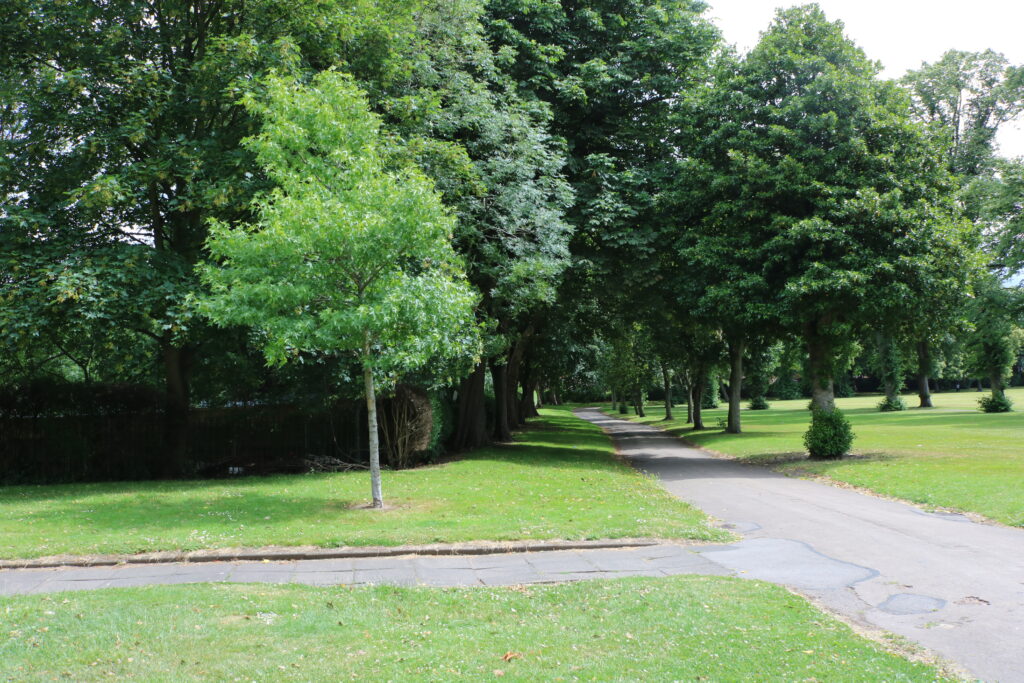
As you walk from the giant beech tree towards the Red Chestnut walk, you will see on your left a smaller tree with five points to each leaf. Originates from eastern USA and was originally introduced to the UK in the 17th Century. It was given its botanical name because of its aromatic gum. It's also one of the best trees for autumn leaf colour; As temperatures fall in autumn, its large , maple-like leaves turn from green to glowing shades of orange, red, crimson and gold. Sweetgum wood is used to make veneer, plywood, cabinets and furniture.
Fun fact: In addition to using the sap as chewing gum, Native Americans and settlers used the sap to treat a wide variety of ailments in both humans and domestic animals. Native Americans used the roots and bark to treat skin disorders, diarrhoea, fevers and other ailments'
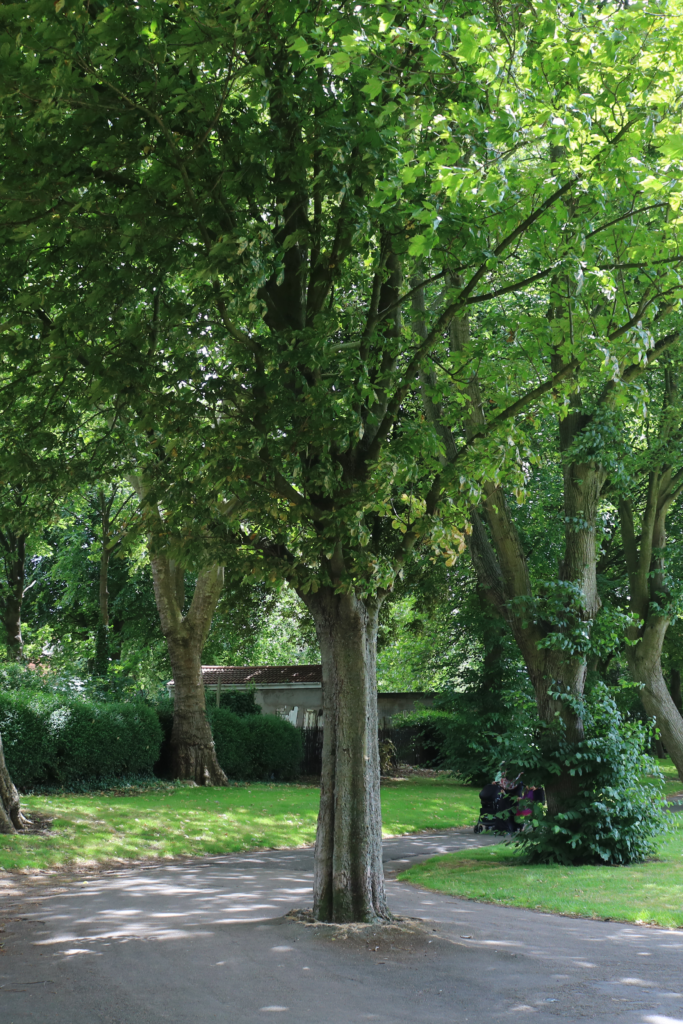
This chestnut tree is a mixture between our well known horse chestnut and a red buckeye. It is a smaller tree than a white horse-chestnut, with darker green leaves. There is a lovely avenue of these trees running towards the centre of the park.
The genus name, Aesculus, comes from the Latin describing an oak that bears edible acorns. The species name, carnea, means flesh coloured or deep pink and refers to the colour of the abundant, candle like rosy pink flowers that appear in May. The fruit is oval to round and produces dark glossy seeds, conkers. The Conker cases are not as spiky or as large as those of the white flowering chestnuts.
The wood of horse chestnut tends to be rather weak, and for this reason it has never been widely used. However, it has absorbent properties that make it ideal for fruit racks and storage trays that keep the fruit dry and thereby prevent rotting.
Fun fact: The conkers are of interest to squirrels and other mammals but poisonous to humans.

Lime trees make a splendid avenue at any time of year. In spring the heart-shaped leaves are bright green, “lime green” of course. You can also recognise a lime tree by the shoots around the bottom of the trunk. Lime trees are often used as street trees and these shoots have to be cut off, as they get in the way of people walking on pavements. They create wonderful shade in summertime. Large-leaved limes are native to much of Europe, and can commonly be found in the south-west of England. Its flowers attract a huge number of insects looking for nectar, while its leaves are popular with caterpillars of the Lime hawk moth, among other species. It produces large-winged, nut-like fruits that disperse its seeds by the wind. As lime wood is soft, it is often used in carving and furniture making, and Lime bark was traditionally used to make rope.
The wood is still used today to make sounding boards and piano keys as it doesn’t warp. The flowers were used to make tea, especially during the Second World War when leaf tea was hard to come by. The tree’s sweet sap was made into wine.
Fun fact: Limes have made many appearances in folklore across Europe. In Estonia and Latvia they are associated with fertility, and in Slavic mythology and German folklore they represent fairness and justice. It was also used to make the poles of Morris dancers!
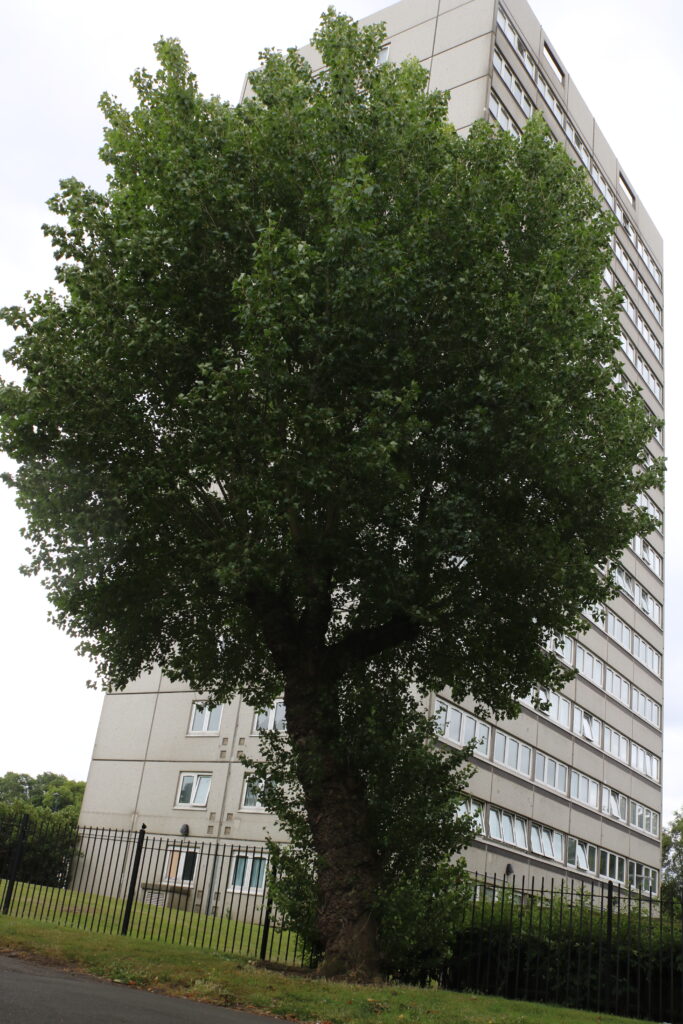
Although the species is declining within the UK, Black Poplar trees can be found at multiple points along the tree trail in the park. A wonderful enormous Black Poplar marks the south-eastern corner of the park. Its leaves will ‘tremble’ in the wind as they have very long stalks. Look at its peculiar rough and knobbly bark with shoots and leaves growing straight out of the almost black trunk.
Later on in the trail, as you go over the bridge, you will see this magnificent line of poplars. They are the same species as the tree in the south east corner of the park, but they have been ‘pikkarded’ or pruned. The heavy top branches have been cut off causing a thick cluster of short branches to grow. Notice the knobbly trunks.
The Black poplar is native to North West Europe, and used to be a staple of Britain’s landscape before their recent decline. Black poplar wood is fine textures, soft, extremely light in colour and naturally fire resistant. Therefore its tradition included wheels and wagons, floorboards and woven baskets. Today, hybrid black poplar timber is also used to make artificial limbs.
Fun fact: According to Greek mythology, the black poplar was created after Phaeton’s fatal attempt to drive Apollo’s chariot. Phaeton's sisters made such a fuss mourning his death that the gods transformed them into black poplars. It is also said that fallen red male catkins are Devil's fingers, and bring bad luck if picked up.

Horse Chestnut trees can be found at multiple spots within the tree trail. All along the Horse Chestnut walk you will see a number of beautiful horse chestnut trees either side of the path as you move towards the centre of the park. Down by the lake you will see another horse chestnut. This one has an interesting trunk and big branches. You can see it from quite a distance from across the park. From this tree, with your back to the lake, if you look to your left there are three large trees in a line. The first is an ash, the second a turkey oak and the third a lime.
Horse Chestnut trees produce white flowers of spring. These are followed by the ‘conkers’, mahogany nuts inside greeny-brown spikey cases. These are very easy to germinate. The leaves have seven leaflets joined to the stalk, like a fan. In late winter they have large sticky brown buds, ready to form new leaves.
Horse Chestnut trees are native to the Balkan Peninsula, and were first introduced to the UK in the late 16th Century. The Horse Chestnut tree is most famous for facilitating the game of conkers, which was first recorded played in the Isle of Wight in 1848.
Fun fact: It is said that horse chestnut is so named because its seeds were once used to treat ailments in horses. It turns out that aescin, which can be extracted from conkers, has anti-inflammatory effects and is an effective remedy for sprains and bruises for humans.

These pine trees were planted by local school children, organised by the charity Birmingham Trees for Life. There are many of these trees growing wild in Scotland- the oldest one is 550 years old. It is the only truly native pine in the UK. These trees are old enough now to have male flowers in spring, which release pollen in the hope of finding a female flower; which will then produce cones. The Scots Pine is the national tree of Scotland.It is a native of the once extensive Caledonian pine forests and is the only timber-producing conifer native to Scotland.
In the past it was used for ships’ masts, as a source of turpentine, resin and tar, and for charcoal. Today Scots pine timber is used for building, pit-props, furniture, chipboard, boxes, fences, telegraph poles and paper pulp.
Fun fact: The needles on young Scots Pine trees grow longer than those on older trees.
The largest tree trunk in the UK belongs to a Scots Pine, the King of the Forest in Muirward Wood. It stands 31 metres tall and its trunk measures a whopping six metres in diameter!

There are several large ash trees growing along this avenue. They are one of the most common trees in the UK and are a vital part of Britain's woodlands, providing food and homes for many species. Their trunks have a regular pattern of grey ridges on them and their leaves are made up of about ten little leaflets all joined to the stalk. The ash produces strong and elastic wood which is used for tools, firewood, furniture and sporting equipment like tennis racquets, cricket stumps and hurling sticks. European ash has also been used in traditional herbal medicines. Its bark was used to treat fevers, its leaves were used to treat gout and enhance urinary and digestive function, and its sap was used to treat earaches. Ash trees are part of the olive family, and produce oil that is chemically similar to olive oil
Unfortunately due to a highly infectious fungal disease known as Ash dieback, the Ash could soon be erased from our woodlands. Fungal spores start growing on ash leaves, then spread to the twigs and cause death of the wood. Once the fungus enters the trunk, it blocks movement of water and nutrients and it kills the whole tree. We hope our trees do not become susceptible to the disease and survive for many years to come.
Fun fact: In Norse mythology, an ash tree supported the universe, and the first man was said to have been carved from its wood.
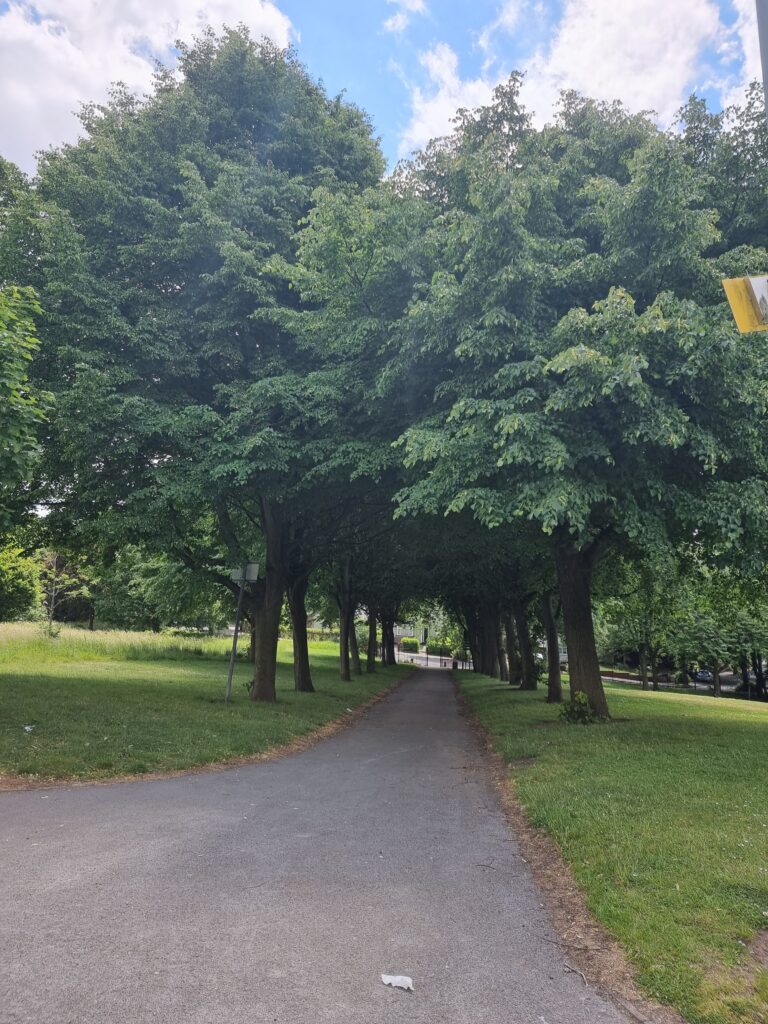
This delightful lime avenue was planted in 1978 with trees grown at the Parks’ Department tree nursery. The small leaves lime can be distinguished from the large leaved Lime by inspecting the underside of the leaves. Whilst the large leaved lime has hairs all over the underside, the small leaved lime leaves are hairless except for reddish brown tufts on the underside of the vein-joints. Lime flowers have been used in the past as treatment for insomnia as headaches.
Fun fact: Dried lime flower blossoms can be used to make lime-flower tea, as the flowers contain an aromatic oil with a pleasing taste.
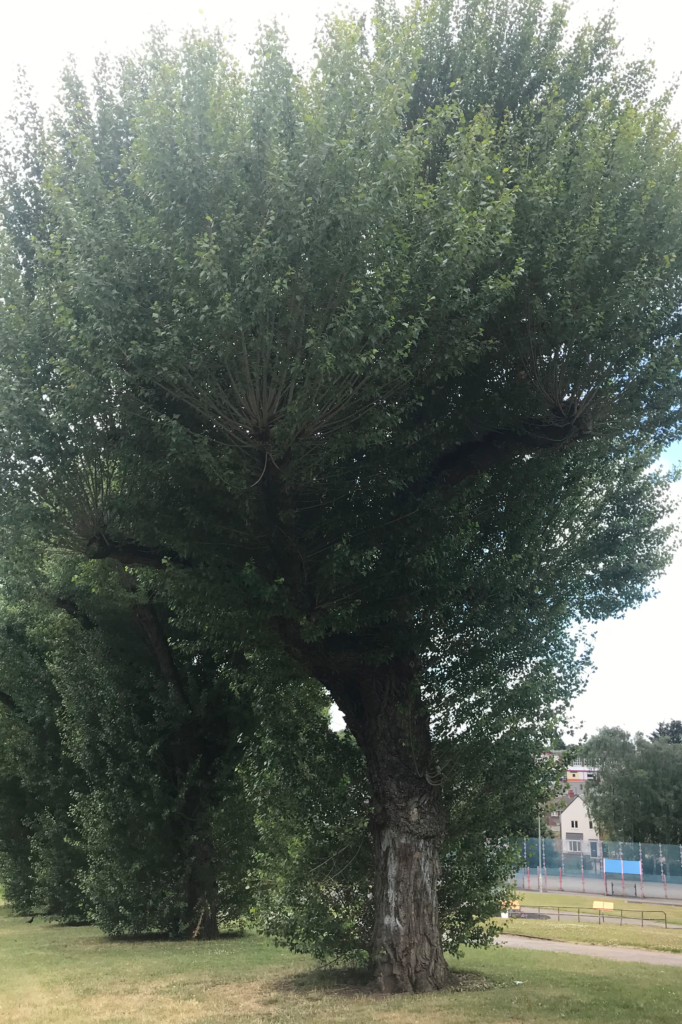
Although the species is declining within the UK, Black Poplar trees can be found at multiple points along the tree trail in the park. A wonderful enormous Black Poplar marks the south-eastern corner of the park. Its leaves will ‘tremble’ in the wind as they have very long stalks. Look at its peculiar rough and knobbly bark with shoots and leaves growing straight out of the almost black trunk.
Later on in the trail, as you go over the bridge, you will see this magnificent line of poplars. They are the same species as the tree in the south east corner of the park, but they have been ‘pikkarded’ or pruned. The heavy top branches have been cut off causing a thick cluster of short branches to grow. Notice the knobbly trunks.
The Black poplar is native to North West Europe, and used to be a staple of Britain’s landscape before their recent decline. Black poplar wood is fine textures, soft, extremely light in colour and naturally fire resistant. Therefore its tradition included wheels and wagons, floorboards and woven baskets. Today, hybrid black poplar timber is also used to make artificial limbs.
Fun fact: According to Greek mythology, the black poplar was created after Phaeton’s fatal attempt to drive Apollo’s chariot. Phaeton's sisters made such a fuss mourning his death that the gods transformed them into black poplars. It is also said that fallen red male catkins are Devil's fingers, and bring bad luck if picked up.

An elegant avenue of birches leads down to the lake. They have light and airy foliage that sways in the wind and white bark. This bark peels off, but the trees are quite healthy. In the spring, some of the trees have catkins and in autumn the leaves are buttery yellow. They do not live to a great age and some of the trees in the avenue have been replaced by new young ones. Silver Birch trees are native to Europe and parts of Asia, and they provide food and habitat for more than 300 insect species.
Fun fact: Silver birches have widely spread roots, which allow it to bring otherwise inaccessible nutrients into the tree. This in turn is recycled onto the surface of the soil when the tree loses its leaves, and because of this, silver birches can be used to improve the quality of the soil that surrounds them.
The silver birch is also Finland's national tree. Leafy, fragrant bunches of young silver birch boughs (called vihta or vasta) are used to gently beat oneself while bathing in the Finnish sauna.

Horse Chestnut trees can be found at multiple spots within the tree trail. All along the Horse Chestnut walk you will see a number of beautiful horse chestnut trees either side of the path as you move towards the centre of the park. Down by the lake you will see another horse chestnut. This one has an interesting trunk and big branches. You can see it from quite a distance from across the park. From this tree, with your back to the lake, if you look to your left there are three large trees in a line. The first is an ash, the second a turkey oak and the third a lime.
Horse Chestnut trees produce white flowers of spring. These are followed by the ‘conkers’, mahogany nuts inside greeny-brown spikey cases. These are very easy to germinate. The leaves have seven leaflets joined to the stalk, like a fan. In late winter they have large sticky brown buds, ready to form new leaves.
Horse Chestnut trees are native to the Balkan Peninsula, and were first introduced to the UK in the late 16th Century. The Horse Chestnut tree is most famous for facilitating the game of conkers, which was first recorded played in the Isle of Wight in 1848.
Fun fact: It is said that horse chestnut is so named because its seeds were once used to treat ailments in horses. It turns out that aescin, which can be extracted from conkers, has anti-inflammatory effects and is an effective remedy for sprains and bruises for humans.

As you look to the right towards the centre of the park, up on the slope stands a majestic Sycamore. Look out for the distinctive shape of this one. These trees are quite common, but this is a large mature one. In the early spring, even before the leaves come out, it produces yellow flowers. These turn into ‘helicopter’ seeds that float on the wind with wings. Its leaves are like your hand, with five sections. Sycamores are native to central, eastern and southern Europe.Sycamore timber is hard and strong, pale cream and with a fine grain, and is excellent for carving. Poland fresh tree sap was drunk as a beverage, leaf buds were eaten raw by shepherds, and leaves were put in the oven under baking bread both to prevent it from sticking and to give it a special flavour . The leaves are still used to wrap local cheese in Northern Spain
It is used to make furniture and kitchenware, such as ladles and wooden spoons as the wood does not taint or stain the food.
Fun fact: Traditional Welsh ‘love spoons’ are crafted out of sycamore wood, and decoratively carved to be given out as romantic gestures.

Beech trees are another type of tree that can be spotted at multiple points along the tree trail, with one in particular (number 9 on the trail) being especially hard to miss. This magnificent tree is one of the largest in the park! Its branches sweep down low, so you can just walk underneath it and look up into its canopy. We think that this tree is well over 150 years old! This green leaf common beach is native to Europe. It is the largest-growing beech, reaching a mature height of at least 25m and forming a wide-spreading densely branched canopy with a minimum spread of 15m. Its leaves are a light and intense bright green in colour when first opening in spring, with a covering of silky hairs. As the growing season progresses the leaves mature to dark green, turning yellow to orange-brown in autumn. Mature trees also bear tiny green flowers in spring followed in autumn by small, brownish bristly-cased capsules that encase tiny nuts known as ‘beech mast. Beach has many practical uses, its timber is suitable for furniture and fuel, and it also makes a popular hedging plant.
Down alongside the lake there is also a lovely stretch of old woodland including beech, oak and sycamore. Beech trees have smooth grey bark, oak darker grey/brown with ridges and sycamore scaly green/grey. As this is natural woodland, any trees that fall over in the wind are left to decay for mini-beasts to eat. In early spring naturalised daffodils flower and in May bluebells carpet this wood.
Fun fact: The beech is associated with femininity, and is often considered to be the ‘queen’ of British Trees, with the mighty oak tree being the ‘king’.

This pretty tree down by the lake was planted to commemorate the Silver Jubilee of King George V in 1935. Planting trees to celebrate royal events became popular in Victorian times when the importance of parks for local people in urban areas was promoted. Can you find two more similar trees in front of the house that were probably planted there at the same time? Copper Beech trees can be easily identified by their purple leaves and smooth grey bark. Copper Beeches occurred from a natural mutation of beech trees across Europe in the 15th century.
Fun fact: In Celtic mythology, Fagus was the god of beech trees. Much like the red leafed copper beech, redheads were also sacred to Fagus.

This is a small tree, so look out for it- there are two of them planted not far away from each other. It grows wild only in the southern hemisphere, such as in South America. It is not common in parks and has been specifically planted here - it is deciduous with small waxy leaves on twigs that are smooth grey zig-zags. It looks very different from our English native trees! Southern Beech is made up of greyish, decorative bark and single, elliptic, beautifully shaped hornbeam-like leaves. When the leaves are young they are of a bronze colour, then during the summer a dark green and in the autumn they turn to a fiery red (sometimes yellow).
Fun fact: The southern beeches have an impressive fossil record that dates back some 80 million years to the late Cretaceous. Their fossils have been found throughout many of the Southern Hemisphere continents including the now-frozen Antarctica.
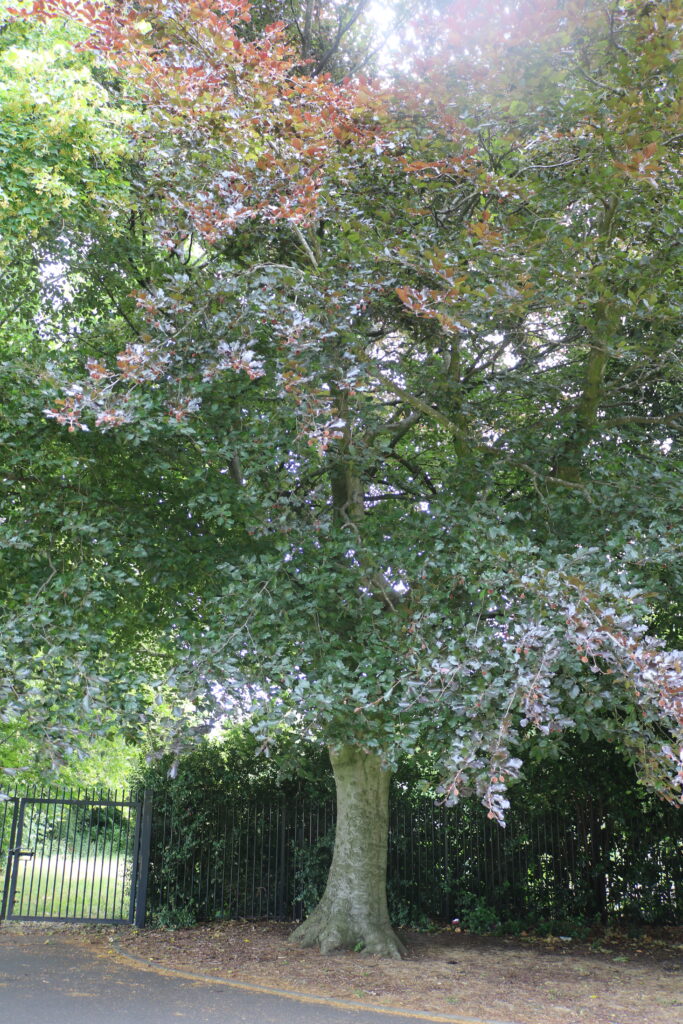
At the corner of the path as it runs past the end of Ward End House garden, is this large tree. In the spring it is one of the last trees to get its leaves- not all deciduous trees grow their leaves at the same time in spring; all through May, different trees take their time. It’s also one of the first to shed its leaves in autumn! This one was already on the ground in the middle of October. Red oaks are native to North America, and extensively used as a forest tree in Britain after 1920. Red Oak Trees don’t start producing acorns until they are about 20 years old. Peak production of acorns doesn’t start until the Red Oak Tree is 50-70 years old, and then, around 80 years old, acorn production slows down. Red oak is mainly planted as an ornamental tree in parks and gardens for its rich autumn colour. The timber is also used, but it is not as strong as that of English and sessile oaks. In North America it is widely used in furniture making, and as lumber for products like fence posts, crates and flooring.
Fun fact: In North America, the red oak is the provincial tree of Prince Edward Island, as well as the state tree of New Jersey.

Just off the path is this very posh sycamore with wonderful yellow splashed leaves- they are brightest in spring. The first of these trees was bred in a tree nursery from a common sycamore and possibly appeared by chance. Growers then grew variegated seedlings until there were lots of trees. The ancestors of this tree were bred in Belgium- King Leopold was on the throne in 1861. It was developed in Belgium and given the name ‘Leopoldi’ in honour of King Leopold.
Sycamore Leopoldii features eye-catching variegated foliage. In the spring months, the foliage emerges a showy creamy pink shade. As the leaves mature they turn a bright green with splashes and speckles of yellow and pink. The leaves are wonderfully unique because no two leaves look exactly the same. The leaf stalks are a purplish-red. The leaves have a maple-type form. During the spring and summer months, the contrasting colours of the foliage are extremely striking. In the autumn, the foliage turns a brilliant yellow before falling from the tree. In the Ryedale area of North Yorkshire it was frequently planted on larger estates and is a common sight in the countryside
Fun fact: the lighter, yellow splashes on the leaves are a result of variegation. This is when there is a lack of chlorophyll (the green pigment) in some of the plant cells.

To the side of the White House you will find two exotic looking palm trees. These hardy evergreen palms are one of the only species of palm that can survive outside in the winter in Britain, and were planted in the park in the early nineteen hundreds. Their trunks are tall, rough in texture and fibrous, and their leaves are dark green and fan shaped at the top. This species of tree is native to parts of China, Japan, Myanmar and India.
Fun fact: This species is also known as a ‘Windmill Palm’ because of the way its large rounded leaves are held above its slender stalk.

In front of the gate to the community garden area stands a magnificent magnolia tree. In springtime this tree produces beautiful sweet smelling white and pink flowers. This particular Magnolia used to reside on Glebe Road in a residential front garden, before it was moved to Ward End Park in 1968. When it was re-planted in the park it only had a single stem, however as it adapted to its new environment this stem died back and three new trunks grew up from the root.
Fun fact: Fossil records have shown us that magnolia plants existed at least 20 million years ago